
An Orchestration of Light and Logic
There is a profound, almost hypnotic satisfaction to be found in the moonlit clearings of Bracken Choir. This rhythm puzzle adventure tasks players with stepping into the role of a wandering conductor, guiding a symphony of luminous woodland creatures to manipulate the environment. Where many rhythm games rely solely on rapid-fire reflexes, this title demands a spatial awareness that elevates its mechanics beyond mere timing. You are not just hitting notes; you are arranging living, breathing instruments in a three-dimensional space to coax ancient mechanisms into life. It is an elegant premise, one that intertwines the auditory and the environmental in ways that feel both novel and deeply rewarding.
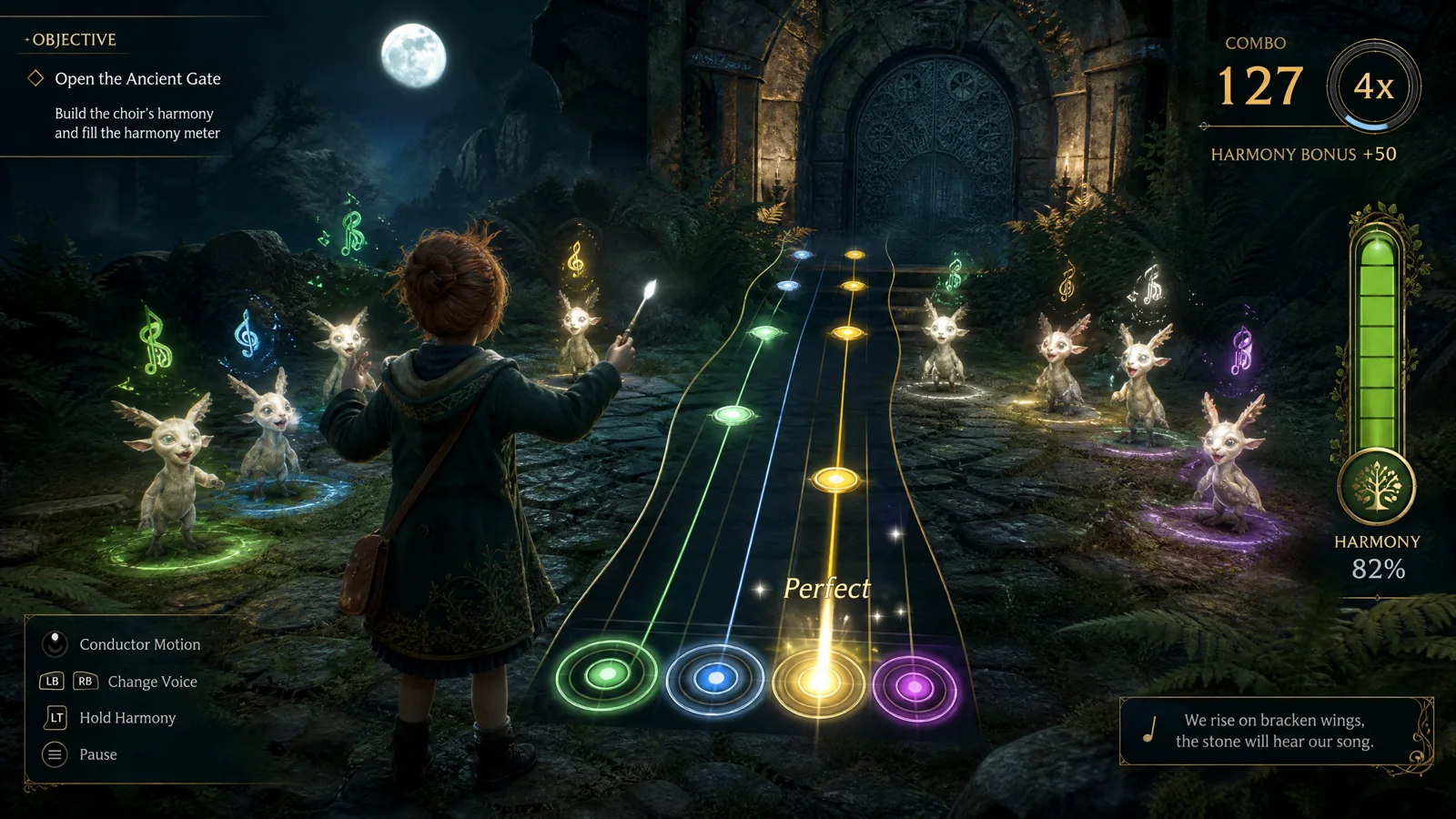
The core gameplay loop is beautifully demonstrated in one of the game's early set pieces: the opening of the Great Stone Gate. Standing before the imposing, rune-carved monolith, the player character must direct a group of glowing, moth-like creatures and resonant beetles. The HUD elegantly displays a rhythm lane that curves around the protagonist, alongside combo counters and a harmony gauge. As the beat of the forest’s natural ambience swells, players must position these creatures using the analogue sticks, whilst simultaneously timing button presses to the rhythm. The creatures' songs resonate with the gate's ancient magic, and when the harmony gauge reaches its zenith, the stone slowly grinds open, revealing the path ahead.
It is in these moments that Bracken Choir truly sings. The synergy between timing and spatial arrangement works together elegantly, creating a flow state that feels less like playing a video game and more like conducting a living orchestra. The controls on the PlayStation 5's DualSense controller are particularly noteworthy, with the haptic feedback providing a subtle, tactile pulse that mirrors the on-screen rhythm. This physical connection grounds the fantastical elements, making the act of conducting feel weighty and deliberate.
Systems and Symphonies
Delving deeper into the mechanics, the game’s systems reveal a surprising layer of depth. The player must manage different types of creatures, each representing a distinct musical section—percussion, strings, woodwind, and brass equivalents. These creatures respond to specific inputs and possess unique environmental interactions. For instance, the heavy, bass-like resonance of the crystalline toads can shatter brittle obstacles, whilst the high-pitched trills of the canopy sprites can activate delicate, wind-chime-like switches. Combining these abilities in time with the overarching rhythm forms the crux of the game’s puzzle design.
The interface is remarkably clean, ensuring that the player's focus remains on the action rather than being cluttered by excessive information. The rhythm lane is integrated organically into the environment, often appearing as a trail of stardust or a glowing vine, rather than a rigid, artificial overlay. This diegetic approach to UI enhances the immersion, allowing the moonlit forests, crystalline caverns, and ancient ruins to take centre stage. The visual design is uniformly gorgeous, employing a painterly aesthetic that makes excellent use of high-dynamic-range lighting to contrast the dark environments with the brilliant, colourful luminescence of the choir.
Performance across the tested platforms is generally robust. On PC and PlayStation 5, the game maintains a fluid sixty frames per second, which is absolutely crucial for a title reliant on precise timing. The Nintendo Switch 2 version, whilst understandably featuring slightly pared-back lighting effects and a lower native resolution, still holds a steadfast framerate, ensuring that the core rhythm mechanics remain uncompromised whether played docked or on the go.
The Middle Movement's Repetition
However, the symphony is not entirely without its discordant notes. While the opening hours are a masterclass in introducing and expanding upon the core mechanics, the game's middle chapter suffers from a noticeable dip in pacing. During this lengthy section, the puzzles begin to feel overly familiar, as the game repeatedly leans on two specific patterns: the sequential activation of pressure plates and the simultaneous routing of light beams.
Instead of introducing new creature types or fundamentally altering the rhythmic challenges, the game merely increases the speed and volume of the required inputs. This overreliance on established formulas momentarily transforms the elegant puzzle-solving into an exercise in rote memorisation. It is a frustrating plateau in an otherwise upward trajectory, and one that tests the player's patience before the brilliant, multi-stage puzzles of the final act finally arrive.
"The true genius of Bracken Choir lies not in the complexity of its individual notes, but in the harmony it achieves when the player learns to listen to the environment as intently as they look at it."
Despite this mid-game slump, the overarching narrative and the sheer charm of the world provide enough momentum to carry the player through. The story is conveyed largely without dialogue, relying instead on environmental storytelling and the expressive animations of the player character and their luminous companions. It is a tale of restoring balance to a fractured ecosystem, and the musical themes perfectly underscore the emotional beats of this journey.
Accessibility and Orchestration
Commendably, the developers have included a robust suite of accessibility options, ensuring that this rhythmic adventure can be enjoyed by a wide audience. The options menu allows for a high degree of customisation, acknowledging that rhythm games can present significant barriers for some players.
- Visual Cues: High-contrast mode for the rhythm lane and distinct colour-blind profiles.
- Timing Forgiveness: Adjustable input windows, allowing for wider margins of error on button presses.
- Audio Mixing: Granular sliders for different instrumental tracks, environmental sounds, and metronome ticks.
- Control Remapping: Full button remapping and the option to toggle holds instead of rapid presses.
These features are integrated thoughtfully, allowing players to tailor the experience to their specific needs without feeling as though they are compromising the core design. The inclusion of a visual metronome, which pulses gently at the edge of the screen, is a particularly elegant solution for those who may struggle to isolate the beat from the game's complex orchestral arrangements.
In its final crescendo, Bracken Choir reaffirms its initial brilliance. The concluding puzzles demand a mastery of everything the player has learned, requiring them to manage multiple creature types across sprawling, multi-tiered environments. When the final chord is struck and the credits roll, the lingering feeling is one of immense satisfaction. It is a title that dares to blend genres in a way that feels organic and purposeful, proving that the rhythm genre still has uncharted territories to explore. Whilst the pacing may falter in its middle act, the overall composition is undeniably a success, cementing Bracken Choir as a truly memorable, and deeply harmonious, adventure.