
A city built on water and worry
There is a profound, creeping tension in watching a river rise. In Greywater Borough, the latest city builder to arrive on PC and Xbox Series consoles, that tension is the foundation of your entire civic enterprise. You are not merely a planner laying out grids of terraced housing and zoning industrial estates; you are a custodian of dry land in an isometric, rain-washed post-industrial canal town. Every decision is weighed against the ever-present threat of flooding, making this one of the most compelling and stressful municipal simulations in recent memory. The water is both your lifeblood and your greatest adversary, and learning to manage its ebb and flow is a masterclass in systemic design.
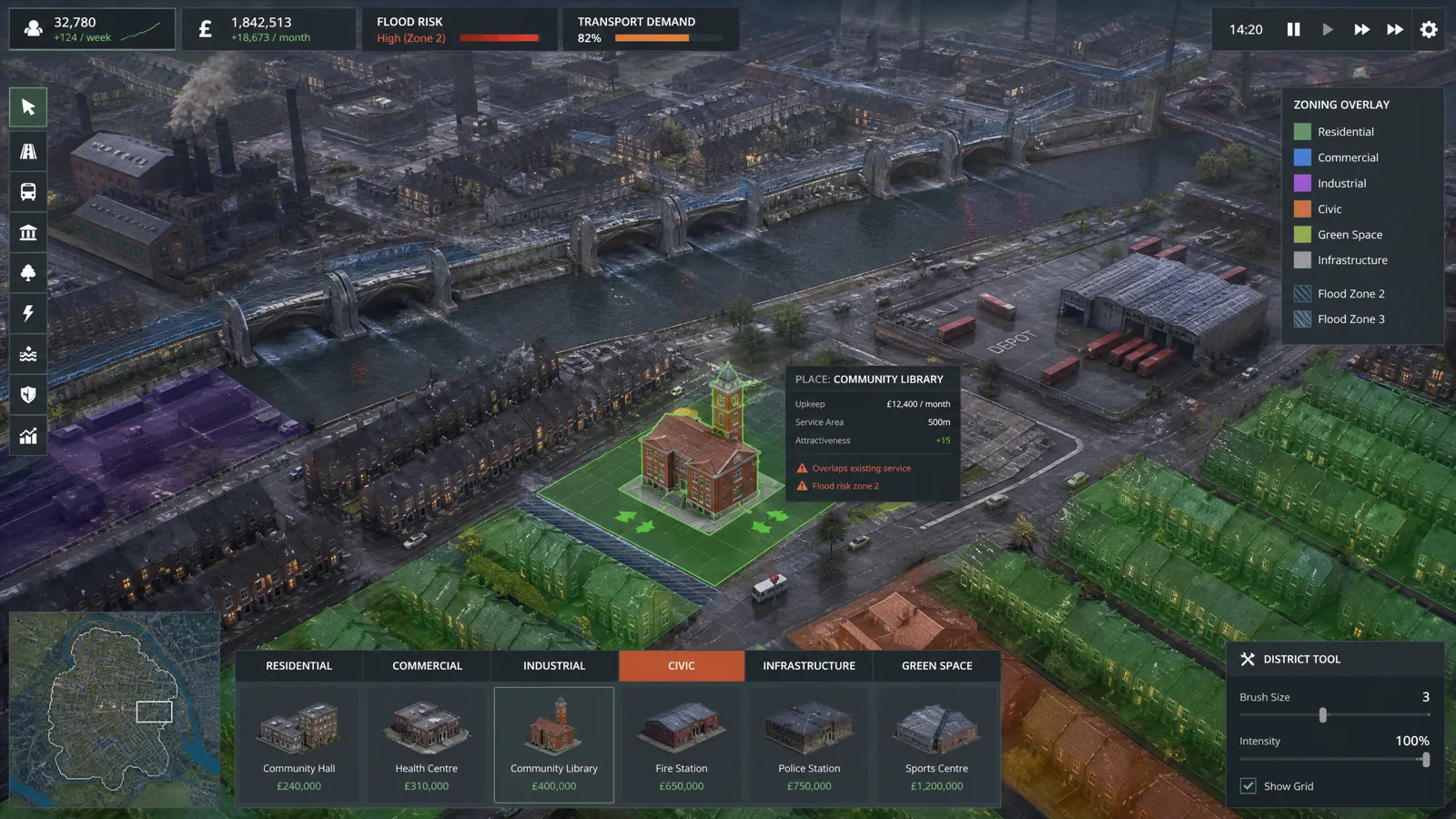
The game presents a beautifully grim aesthetic. The isometric perspective offers a detailed view of rain-slicked cobbled streets, towering brick chimneys, and the sluggish, slate-grey canals that carve through the boroughs. When the rain intensifies, the visual feedback is immediate and alarming. Puddles form, the canals swell, and the HUD pulses with warnings. Your budget, flood risk, transport efficiency, and zoning demands are all elegantly displayed, ensuring you are constantly aware of the precarious balance holding your town together. It is a game where civic pride is measured not in gleaming skyscrapers, but in dry feet and functional bus routes.
At its core, Greywater Borough is a game about inequality, expressed through the medium of urban planning and water management. The affluent citizens demand high-ground real estate, safe from the damp and the deluge, while the working classes are inevitably pushed towards the flood plains and the shadow of the industrial zones. As the mayor, you are tasked with mitigating this disparity, but the tools at your disposal—flood barriers, pumping stations, and drainage networks—are punishingly expensive. Balancing the budget while attempting to protect the most vulnerable neighbourhoods requires a level of foresight and ruthlessness that is genuinely thought-provoking.
Systems of survival
The interplay between flood control and transport is where Greywater Borough truly shines. The town relies heavily on its bus network and canal barges to move workers and goods. However, a sudden downpour can render low-lying roads impassable, severing critical transport links and causing industrial production to grind to a halt. You must design your infrastructure with resilience in mind, elevating key routes and investing in costly flood defences to ensure the city continues to function during the inevitable storms. It is a brilliant, interconnected system that forces you to think about urban planning in three dimensions.
Controls on both PC and Xbox are intuitive and responsive. The PC version benefits from the precision of a mouse for intricate zoning and barrier placement, but the console port is remarkably well-adapted. Radial menus and smart snapping tools make navigating the complex HUD and laying out transport networks a breeze on a controller. The pacing is deliberate, starting as a gentle introduction to zoning and basic services before slowly ramping up the rainfall and the complexity of the demands placed upon you. Performance is rock-solid across both platforms, with the game maintaining a smooth frame rate even when the screen is filled with rushing water, bustling traffic, and hundreds of tiny, umbrella-wielding citizens.
Accessibility options are commendable, offering scalable UI elements, colourblind modes that ensure the vital flood-risk heat maps remain legible, and the ability to pause or slow down time during critical weather events. These features are essential, as the cognitive load can become overwhelming when a storm hits and multiple districts begin to take on water simultaneously.
"In Greywater Borough, a sudden storm is not merely a visual effect; it is an economic crisis, a logistical nightmare, and a stark reminder of the fragile boundary between order and chaos."
The cost of progress
Despite its brilliance, the game is not without its flaws. The mid-to-late game introduces a heavy reliance on industrial expansion to fund the increasingly elaborate flood defences required to keep the town afloat. This creates a feedback loop that, while thematically resonant, eventually becomes mechanically repetitive. The demands of the industrial sector—coal, steel, and heavy manufacturing—dictate the layout of your later boroughs, leaving less room for the organic, creative city-building that characterises the early hours. You find yourself endlessly optimising supply chains and battling pollution, rather than shaping a unique civic identity.
This repetition is compounded by the somewhat rigid zoning requirements. While the early game allows for a charming mix of residential terraces and light commercial properties, the later stages demand massive, sprawling industrial estates to meet production quotas. The constant need to expand these zones, whilst simultaneously protecting them from the rising waters, can feel like a relentless, joyless grind. The narrative of the game—that industrial progress comes at a terrible environmental and social cost—is powerfully conveyed, but it occasionally comes at the expense of player enjoyment.
Nevertheless, the systems governing the town's daily life remain fascinating. The transport network, in particular, requires constant tweaking and optimisation. A well-planned bus route can alleviate congestion and improve the happiness of your citizens, but a poorly placed depot or a flooded arterial road can lead to cascading failures across the entire city. The satisfaction of finally perfecting a transit loop, ensuring that workers arrive at the factories on time and goods are distributed efficiently, is immense.
A foundation built to last
Here is a brief overview of the key systems you will need to master:
- Flood Defences: Essential infrastructure including sea walls, pumping stations, and overflow reservoirs. High maintenance costs require careful budgeting.
- Transport Networks: Bus routes and canal barges. Vulnerable to flooding; requires elevated roads or resilient planning.
- Zoning: Residential, commercial, and industrial. Wealthier citizens demand high ground, forcing difficult ethical and planning decisions.
- Civic Budget: Driven by taxes and industrial output. Must be carefully balanced against the constant drain of infrastructure maintenance.
Ultimately, Greywater Borough succeeds because it makes you care about the minutiae of municipal governance. It is a game that understands that the most dramatic moments in a city builder do not come from alien invasions or natural disasters, but from the slow, creeping realisation that your drainage system is inadequate for the coming storm. It forces you to confront the consequences of your planning decisions, blending the satisfaction of systemic mastery with a poignant commentary on class, infrastructure, and the environment.
While the late-game industrial demands may drag, the core loop of building, protecting, and managing this rain-washed, post-industrial town is deeply compelling. It is a meticulous, stressful, and rewarding experience that earns its place among the elite of the genre. Greywater Borough is a stark reminder that in the face of rising waters, a dry pair of socks is the ultimate luxury, and providing them is a mayor's most sacred duty.