
Beneath the Cobblestones
There is a certain undeniable charm to the world that exists just out of sight. Above ground, the citizens of this fictional Victorian-esque metropolis go about their respectable, soot-stained lives, oblivious to the subterranean machinations below. Under Clerk Street, a turn-based dungeon tactics game released for PC and the upcoming Nintendo Switch 2, invites players to abandon the polite society of the surface. Instead, it asks you to delve into the brick-lined tunnels and flooded archives that form the city's hidden nervous system. It is a game of meticulous positioning, resource management, and the constant, pressing need to keep the darkness at bay.
The premise is deceptively simple: you command a four-person party of urban explorers, scavengers, and disgraced academics, navigating a treacherous labyrinth of forgotten municipal works. Your adversaries are not the typical fantasy fare, but rather mechanical pests—clockwork vermin, malfunctioning steam-driven security automata, and the occasional feral maintenance drone. This setting provides a refreshing departure from the usual high-fantasy tropes, grounding the tactical combat in a world of brass, damp brickwork, and flickering gaslight.
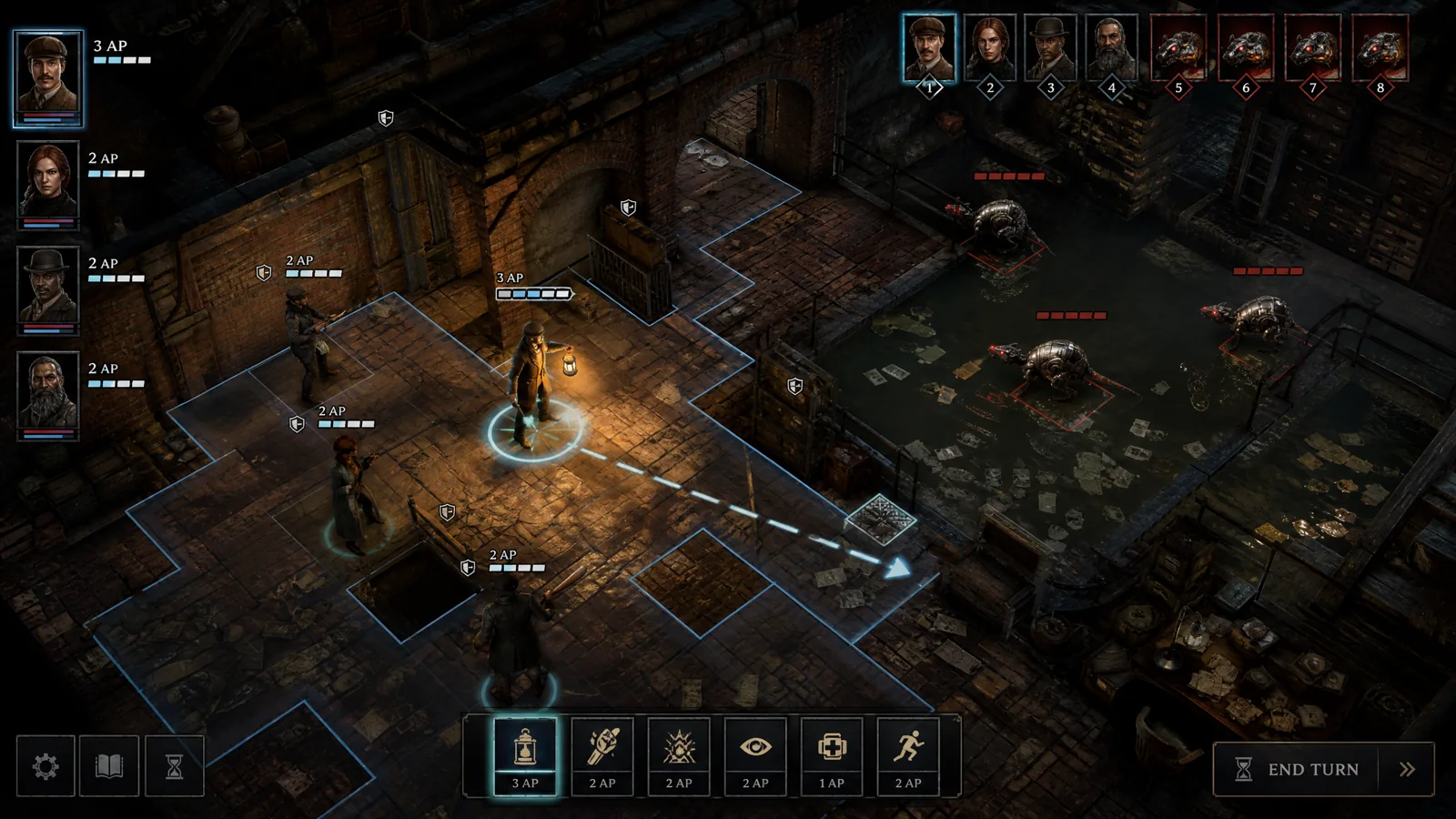
From the moment you deploy your squad into the isometric gloom, the game's central mechanic becomes apparent: light is life. Lantern control is not merely a thematic flourish; it is the axis upon which every encounter turns. Areas shrouded in darkness confer severe penalties to accuracy and evasion, whilst simultaneously granting mechanical horrors the cover they need to flank your vulnerable backline. Managing your limited supply of lamp oil, strategically placing flares, and using character abilities to illuminate the battlefield are just as crucial as dealing damage.
The Geometry of Survival
Combat in Under Clerk Street unfolds on delightfully compact maps. The developers have eschewed sprawling, multi-tiered battlefields in favour of tightly constrained environments that force immediate engagement. A typical encounter might take place in a flooded archive, the water impeding movement while crumbling bookshelves offer precarious cover. This density ensures that every action point matters, and positioning is paramount. You are never more than a turn away from disaster, but neither are you far from a brilliantly orchestrated victory.
The heads-up display is clean and communicative, providing a clear overview of action points, cover values, initiative order, and ability ranges. The initiative system, in particular, deserves praise. It is dynamic, allowing certain actions—like a well-timed suppressing fire or a tactical retreat—to alter the turn order. This fluidity prevents the combat from feeling like a rigid exchange of blows, transforming it instead into a reactive puzzle where anticipating the enemy's next move is vital.
"The brilliance of the combat lies not in overwhelming force, but in the elegant manipulation of space and light. A well-placed lantern can turn a desperate defensive stand into a devastating ambush."
However, the transition from PC to the Nintendo Switch 2 highlights a few minor control quirks. While the mouse and keyboard setup on PC is intuitive, allowing for precise targeting and easy camera manipulation, the gamepad controls can occasionally feel a bit fiddly when selecting overlapping units in tight corridors. It is by no means a dealbreaker, but it does require a period of adjustment. Fortunately, the performance on both platforms is rock solid, with smooth frame rates that maintain the tension even when the screen is filled with particle effects from bursting steam pipes and sparking automata.
Systems and Subterfuge
Beyond the immediate thrill of combat, Under Clerk Street boasts a robust character progression system. Each member of your party belongs to a distinct class, ranging from the heavy-hitting 'Trench-Fighter' to the support-oriented 'Archivist'. Skill trees are expansive, allowing for significant customisation. You might build a rogue-like character who excels at exploiting darkness, or a heavily armoured tank designed to draw fire and hold chokepoints.
The synergy between these classes is where the game truly shines. Combining an Archivist's 'Phosphorous Flare' with a Trench-Fighter's 'Overwatch' ability creates a deadly kill-zone that can decimate advancing mechanical pests. Discovering these combinations and tailoring your squad to suit your preferred playstyle is immensely satisfying.
Yet, for all its tactical brilliance, the game stumbles when it comes to inventory management. The equipment comparison interface is, frankly, cumbersome. When scavenging for weapon upgrades or defensive gear in the murky depths, players are forced to navigate a labyrinthine menu system that obscures vital statistics.
- Weapons: Comparing damage ranges, critical hit chances, and armour-piercing values requires toggling between multiple screens.
- Armour: The distinction between physical resistance and elemental (steam/electric) defence is poorly signposted.
- Trinkets: Small stat boosts are often buried under flavour text, making it difficult to discern their actual utility at a glance.
This lack of clarity is frustrating, particularly in a game where marginal numerical advantages can mean the difference between a successful extraction and a total party wipe. One spends too much time wrestling with the user interface when they should be strategising their next delve.
Pacing in the Dark
The pacing of the campaign is generally well-judged. The narrative unfolds through environmental storytelling and brief, atmospheric text logs discovered in the ruins. It is a slow burn, gradually revealing the extent of the subterranean corruption and the true nature of the mechanical threat. Between missions, you return to a makeshift hub—a disused underground station—where you can heal, upgrade equipment, and interact with your crew. These interludes provide a necessary breather from the relentless tension of the tactical encounters.
Accessibility has also been thoughtfully considered. The game offers a range of difficulty options, allowing players to tailor the experience to their skill level. There are options to highlight interactive elements, adjust the size of the text, and even a 'story mode' that significantly reduces the challenge of combat for those who simply wish to explore the world. Furthermore, the inclusion of colour-blind friendly palettes ensures that the crucial distinction between illuminated and shadowed tiles is clear to all players.
A Light in the Gloom
Despite its interface woes, Under Clerk Street is a remarkable achievement in the turn-based tactics genre. It is a game that understands the value of constraint, using its compact maps and limited resources to generate genuine tension. The interplay between light and shadow elevates the combat from a simple numbers game to a nuanced spatial puzzle. It demands your attention, punishes carelessness, and immensely rewards tactical foresight.
The setting is evocative, the mechanics are sound, and the atmosphere is thick enough to cut with a rusted trench knife. While the cumbersome equipment comparison may occasionally break the immersion, the core gameplay loop remains compelling throughout the twenty-hour campaign. For those willing to brave the darkness and master the intricacies of lantern control, the rewards hidden beneath the respectable city are well worth the effort. It is a glowing endorsement of thoughtful design in a crowded genre, earning its place alongside the best tactical experiences available today.